 Image 1 of 1
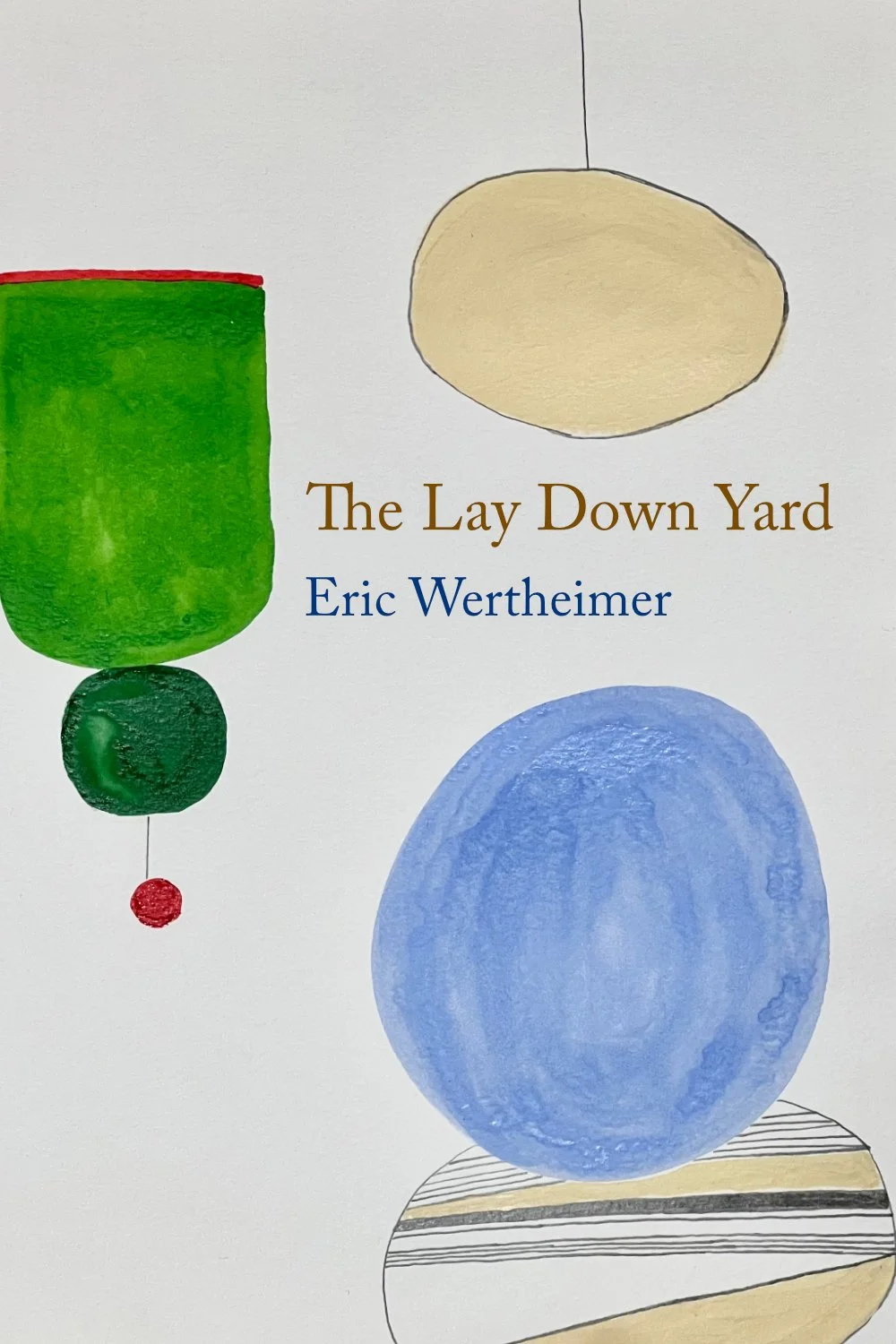
Eric Wertheimer’s third book of poetry, The Lay Down Yard, collects poems that travel a geography of loss and repair, generating broken grammars and lyric logics. The poems capture flashpoints from a migration compassing the Arizona desert, the Gowanus Canal, and the inlets of Mattituck. The subjects of the poems are wildly various—tech and media, nature and geography, early American cultures, fatherhood, and romantic love. Some hit the lyric, some speak in glitched sentences, and some just make bad jokes. The transit of the book finds trees; as places to secure things, and as places to hear songs of return and rebuilding.
Painters, musicians, and friends appear in these poems, Lincoln, Jefferson and Kafka too. We travel through cities as well as the natural world. Trees fall and ignite light, carpenter bees claim the air, there's an eclipse, no two, "and the sun, now like us in its transit, / limited and mortal, / always rising" ("Last Eclipse"). Marriage and children appear with love, saturated by time. "The heart makes you live lifetimes in short days." ("Emily") As you can see there's an elegance to these poems, but also a sweetness (in the best sense of that word), and wit too. Reading a collection of poems should give everyone as much pleasure as The Lay DownYard gave me. A "Sign of good luck, penance, / and healing." ("A Coopers Hawk") Read on Dear Reader. Read on.
—Miranda Beeson, author of Wildlife, and Field Sonnets
The Lay Down Yard is a personal and intimate portrait of a “scrapyard forest,” of survival and viability unfolding in chapters, and of self-reflections in examined domestic spaces, academic field guides, and literal walks among wilderness and urban wildlife. In fact, Wertheimer invites readers to walk alongside his observations asking: How does one track complicity and camaraderie in the decisions that shape who we are? These poems flourish across geographies and narratives of migration, gathering cues from the physical and emotional landscapes and histories that range from political to pastoral systems, from roots to canopies, from “the conditions we / walk beside, parch, and cultivate…as new sound scriptures”
—Michelle Whittaker, author of Spoke the Dark Matter
"Eric Wertheimer writes poems the way certain people think after midnight: associative, wounded, silly, and suddenly devastating. The Lay Down Yard is filled with scrapyards, highways, broken trees, earaches, eclipses, and spiritual static, all rendered in language that feels both deeply American and completely singular. These poems refuse easy wisdom, which is precisely why they linger."
—Matt Dadonna, author of The Longitude of Grief
"A turnbuckle, a dishwasher, an ash tree, a swan’s leg, an insurance rate quote: nothing remains merely itself, neither 'a this, nor a that,' in Eric Wertheimer’s The Lay Down Yard. A sustained act of attention, this collection reminds us that our lives can be stranger, and more illuminating, than 'our first imagination of them.' Transforming the quotidian into sites of astonishment, grief, and laugh-out-loud humor, Wertheimer’s poems are generously shared meditations on memory, love, wonder, and survival, reawakening us all to the mysteries of being alive in this world."
—Molly Gaudry, author of We Take Me Apart
Coiled and swaled, Wertheimer's deftly stirring poems, like those of Melville and Stevens, whittle a language from the edges of distress. They find and as often leave a voice there—the brilliant, modest gesture of its vouch—that is adequate to and searingly intimate with the distinctly American travail on which the softness of our days is hung. Peering through the fence one is, the wisdom of Lay Down Yard extends a “cornice/Light,” the “evening compassion of/ a held bone.” Recalling the etymology it shares with girders and gardens, we could say that the yard of this book’s intelligence lays itself on the line of what it cannot grasp. Like sugaring bees, the ‘opal decisions’ of these “realborn” threshold poems ‘put weight in the air.’
—Michael Snediker, author of Jones Very
Eric Wertheimer is a professor of English at Stony Brook University. He is the author of two other books of poetry, Mylar (2012) and Regulus (2018), as well as scholarly monographs Imagined Empires: Incas, Aztecs, and the New World of American Literature, 1771-1876, (Cambridge University Press, 1998), and Underwriting: The Poetics of Insurance in America, 1722-1872, (Stanford University Press. 2006); a collection of essays Critical Trauma Studies: Understanding Violence, Conflict, and Memory in Everyday Life, co-edited with Monica Casper appeared with NYU Press in 2016. He has received fellowship and grant support from the Mellon Foundation and the Luce Foundation. He lives on the east end of Long Island.
Author website: ericwertheimer.com
Book Information:
· Paperback: 94 pages
· Binding: Perfect-Bound
· Publisher: BlazeVOX [books]
· ISBN: 978-1-60964-551-9
$18